How to Get Your Brand Recommended by ChatGPT and Google AI Overviews in 2026
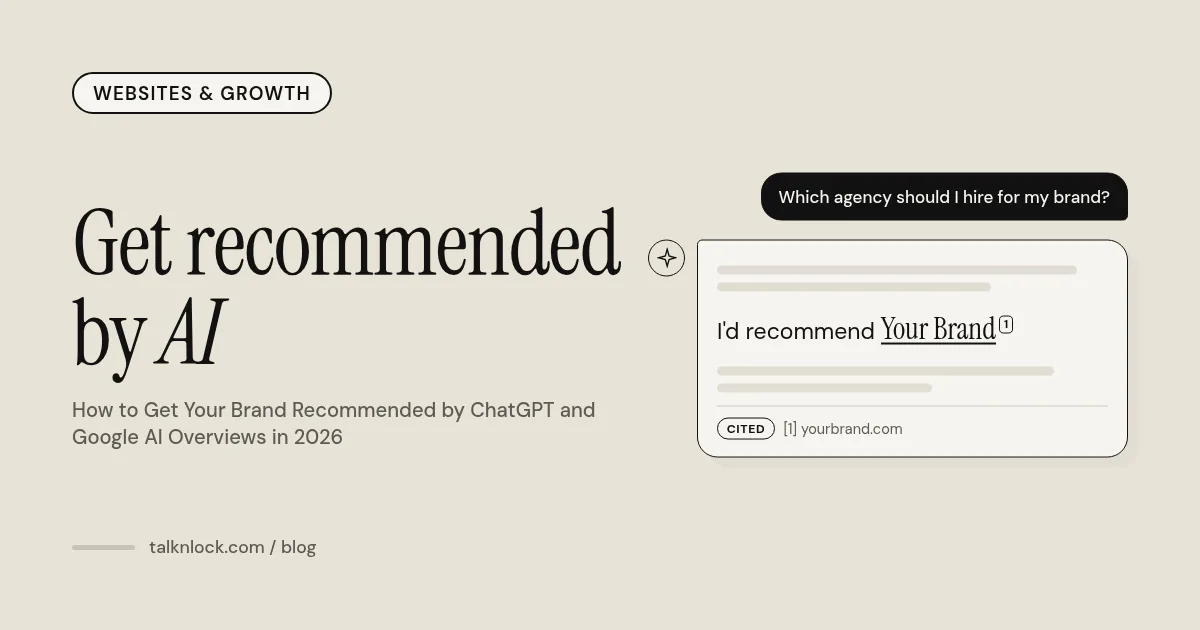
In short: AI assistants such as ChatGPT search, Google AI Overviews and Perplexity build their answers from web pages they can find, crawl and trust. You cannot buy a place in those answers, and Google says there is no special trick for its AI features. What works is the same groundwork that earns you search traffic, done thoroughly: let the right crawlers in, write clear answers to the questions your buyers ask, prove you are a real and credible business, and get other reputable sites talking about you. Below are the nine steps we recommend.
Why AI answers matter for your business
More of your potential clients now ask an AI assistant before they ever click a blue link. A US homeowner might ask ChatGPT to suggest a roofing company. A UK founder might ask Perplexity which accounting software suits a small team, or see a Google AI Overview summarising the options at the top of the results page. In each case, the answer names a handful of brands and links to a few sources. If your business is not one of them, you are invisible at the moment the buyer is forming an opinion.
Can you actually influence this? Our honest answer is yes, more than the hype suggests. Each of these tools publishes guidance on how it finds content, and once you read it, the picture is less mysterious than people make it sound.
How ChatGPT, AI Overviews and Perplexity choose their sources
Google AI Overviews and AI Mode
Google's own page on this, AI features and your website, is refreshingly blunt, and we wish more of the industry read it. Short version? There's no extra checklist for AI Overviews or AI Mode, and no special optimisation. If your page is indexed and allowed to show a snippet in normal Search, it can be picked as a supporting link. That's it. The interesting bit is something Google calls "query fan-out": the system may fire off several related searches on subtopics before writing its answer. So a page that nails one narrow subtopic gets more shots at being pulled in, which is good news for smaller firms with focused pages.
Same page, and this is the part we'd underline twice: no new machine-readable files, no "AI text files", no special schema needed. So when someone pitches you a magic file that guarantees AI visibility, smile politely and keep your wallet shut.
ChatGPT search
OpenAI's crawler documentation explains that ChatGPT's search features use a crawler called OAI-SearchBot. Sites that block OAI-SearchBot will not be shown in ChatGPT search answers. A separate crawler, GPTBot, collects content that may be used to train OpenAI's models. The two settings are independent, so you can allow search visibility while opting out of training if you prefer.
Perplexity
Perplexity's bot guide is short and worth five minutes. PerplexityBot is the crawler behind the sites it surfaces and links in search results, and Perplexity wants you to allow it in robots.txt. One catch we've seen trip people up: a web application firewall can still turn it away unless you add an explicit allow rule.
So the starting point is plain. The bots have to be able to reach your pages, the pages have to be indexed, and then yours needs to be the most useful answer to the question someone typed.
9 steps to get your brand recommended in AI answers
1. Let the right crawlers in
Open your robots.txt file (yourdomain.com/robots.txt) and check that you are not blocking Googlebot, OAI-SearchBot or PerplexityBot. Plenty of sites added blanket "block all AI bots" rules over the last few years without realising it also takes your site out of AI search results. Then check one level deeper: your hosting provider, CDN or security plugin may block bots even when robots.txt allows them. Google's documentation specifically mentions making sure crawling is allowed "by any CDN or hosting infrastructure", and Perplexity gives firewall instructions for the same reason.
A quick aside on training. If you would rather your content was not used to train AI models but still want to appear in answers, allow OAI-SearchBot and disallow GPTBot. Either choice is reasonable. Just make it on purpose.
2. Make sure your key pages are indexed
This one is short, and it is the step people skip. Verify your site in Google Search Console and Bing Webmaster Tools. Submit an XML sitemap, then use the URL inspection tools to confirm that your homepage, service pages and best articles are indexed. Look for stray noindex tags, especially after a redesign or a move from staging.
If a page is not indexed, it cannot be cited. Full stop.
3. Map the questions your buyers actually ask
AI assistants answer questions, so start with questions. List the 20 to 30 things prospects ask your sales team, on calls and in emails. Imagine a dental clinic in Manchester (a hypothetical example). It hears "How much is Invisalign here?" and "Is it worth it at 40?". A made-up software reseller in Texas hears "Which CRM suits a ten-person sales team?". Write down the follow-up questions too, because people rarely stop at one. These conversational queries are exactly the kind an AI tool breaks into subtopics, and each one is a chance to have a page that answers it better than anyone else.
4. Answer each question clearly in the first lines
Structure pages so the answer is easy to lift. Use a descriptive heading that mirrors the question, then give a direct two- or three-sentence answer before you expand on it. Follow with detail: steps, comparisons, examples, caveats. Picture a hypothetical Bristol accountant with a page titled "Our Services". Rename a section "How much does a small-business tax return cost?", answer it in two sentences with a price range, and you have given an AI tool something it can quote. Use short paragraphs, numbered lists for processes and tables for comparisons. Keep important information in text, not only inside images or videos. Google lists "making sure that important content is available in textual form" among its best practices for AI features.
5. Publish things only you can say
AI answers draw on many similar pages, so generic content blends into the crowd. Google's guidance on creating helpful, reliable, people-first content asks whether your content provides original information, research or analysis, and whether it adds substantial value compared with other pages.
The pages most worth citing have real substance. Publish your actual pricing ranges and explain what pushes a project up or down. Write case studies that say what went wrong before things went right. Explain your process the way you would to a client across the table. If you have data from your own projects, share it and say how you collected it. And be willing to say when you are not the right fit, because an honest comparison is far more useful to a buyer, and to an AI summarising options, than another page calling itself the best.
6. Show who is behind the content
Put a name on your articles. Google's helpful content guidance encourages clear bylines, author information and some explanation of how the content was produced, and readers like knowing who they are hearing from too. Beyond that, keep an About page that says plainly who you are, where you work and who you serve, and make your contact details easy to find.
7. Keep your brand facts consistent across the web
Here is a test worth five minutes: search your own company name and read the first page of results as if you were a stranger. Do your website, Google Business Profile and directory listings describe the same business? When an AI assistant recommends a business, it is often combining information from several places: your website, your Google Business Profile, directories, review sites, social profiles and articles that mention you. If your services, locations or even your company name differ between them, you make it harder for any system to be confident about you. Audit your listings. Google's documentation also recommends keeping your Business Profile and Merchant Center information up to date. Use the same name, the same description of what you do and the same contact details everywhere.
8. Earn mentions on sites AI tools already trust
AI answers often draw on third-party sources such as industry publications, comparison articles, review platforms, community forums and podcasts. Your own website saying you are great carries less weight than respected outsiders saying it.
Start with reviews, since happy clients are usually glad to help if you ask at the right moment, straight after a project lands well. Offer expert comments to trade publications in your sector; editors are always short of people who will speak plainly. Get listed in the directories your industry actually uses. Answer questions in the forums and communities where your buyers hang out, without turning every reply into a pitch. If you go on a podcast, check the show notes link back to you. None of this is new. It is digital PR, and we think it is the most underrated part of AI visibility because it helps your ordinary rankings at the same time.
9. Use structured data accurately, and keep content fresh
Structured data such as Organization, LocalBusiness, Article and FAQPage markup helps search engines understand your pages. Google is clear that no special schema is needed for its AI features, and that structured data should match the visible text on the page. Treat schema as an accurate label, not a shortcut.
Freshness is the easier win. Review your most important pages regularly. Update prices, dates, screenshots and examples so that your page stays the most accurate answer available.
How to measure your AI visibility
There is no proper dashboard for AI citations yet, so you have to piece it together. Google says clicks and impressions from AI Overviews and AI Mode are counted in the Search Console Performance report under the "Web" search type, so that is where your Google numbers live. In Google Analytics, check referral traffic from chatgpt.com and perplexity.ai.
Then do it by hand. We suggest that once a month you ask ChatGPT, Perplexity and Google the same ten buyer questions and note which brands and sources come up. The answers shift from one session to the next, so watch the trend over a few months rather than reacting to one result. Finally, add an "AI assistant" option to the "How did you hear about us?" question on your enquiry form. Plenty of people read an AI answer and then type your name straight into the browser, and that visit never shows up as a referral.
Mistakes to avoid
The most common one is the accidental block: a security plugin or CDN rule that quietly turns away AI crawlers. The second is volume over value. Publishing fifty thin, machine-written articles that repeat everyone else will not get you cited, and it can drag down how search engines see the rest of your site. We also see businesses hide every useful detail behind "contact us for a quote", when that is exactly what buyers are asking AI tools about. And please be sceptical of anyone promising guaranteed AI rankings. Nobody can promise that, us included.
Frequently asked questions
Can I pay to be recommended by ChatGPT or Google AI Overviews?
No. And we'd be suspicious of any agency, ours included, that hints otherwise. Google AI Overviews, ChatGPT search and Perplexity don't put organic answers up for sale; a page earns its place there by being crawlable, indexed, useful and trusted. Paid ads are something else entirely: a separate product, labelled as ads.
Do I need an llms.txt file or special schema to appear in AI Overviews?
Google says you do not need new machine-readable files, AI text files or special schema markup to appear in AI Overviews or AI Mode. Standard SEO best practices apply. Accurate structured data is still useful for describing your pages.
Will blocking GPTBot remove my site from ChatGPT answers?
Not on its own. OpenAI says GPTBot is used for model training, while OAI-SearchBot is used to show sites in ChatGPT search. You can block GPTBot and still allow OAI-SearchBot. Blocking OAI-SearchBot will keep your site out of ChatGPT search answers.
How long does it take to start appearing in AI answers?
It varies. OpenAI says robots.txt changes take about 24 hours to reach its search systems, and Perplexity says they can take up to 24 hours, but earning citations depends on your pages being indexed, competitive and trusted, which usually takes months of consistent work rather than days.
Is AI search optimisation different from SEO?
Mostly it is SEO done well, with extra attention on clear answers to specific questions, consistent brand information across the web, and mentions on trusted third-party sites. The foundations are the same.
Want to know how your brand shows up today?
Getting cited in AI answers comes down to a clear website, useful content and a brand that the rest of the web recognises. That is the work we do every day at Talknlock for growing businesses in the US and the UK, across branding, content and websites. If you would like a second pair of eyes on how your brand shows up in AI search, get in touch with our team for a friendly, no-pressure chat.