AEO for Indian D2C Brands: How to Get Your Products Picked in AI Shopping Answers
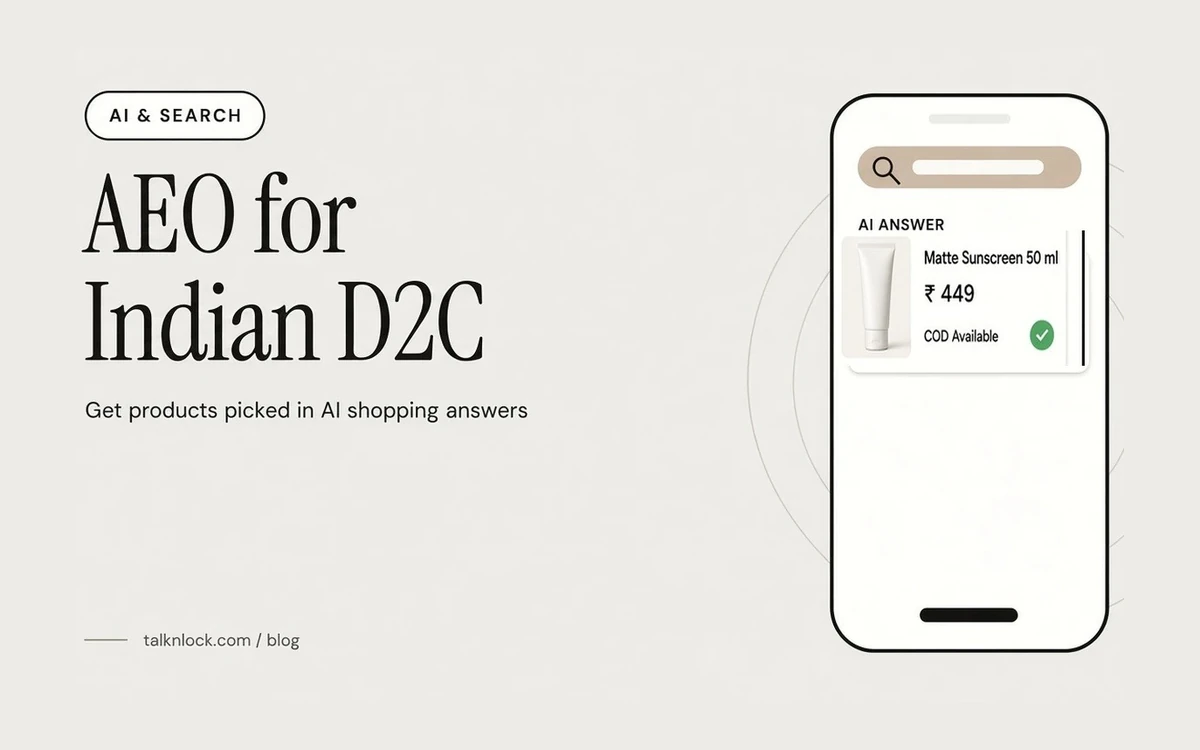
Last week, over cutting chai near C-Scheme, a skincare founder showed us her phone. She'd typed "sunscreen for oily skin under ₹500, COD chahiye" into ChatGPT. Four products. None hers. One belonged to a brand she says "spends half what we do on Meta, yaar."
Quick note before we start. On 23 October we wrote about getting your brand recommended by ChatGPT and Google AI Overviews, which is about your name coming up. Different problem. Here I mean the actual product, the 50 ml tube at ₹449, being the thing the assistant suggests.
Okay but how many people actually shop like this?
More than I'd assumed, honestly. BCG's October 2026 survey found AI chat tools show up in 22% of Indian purchase journeys, about twice the Asia figure (BCG). And of the Indian shoppers who used one, 65% said it swayed which brand they picked (Storyboard18).
Parul Bajaj from BCG India put it more bluntly to The Economic Times. Eighteen months ago LLM search barely existed. Now it's one of the three biggest ways Indian consumers discover stuff (Economic Times).
One in five. I'd want to be in that answer.
What the assistant is looking for (it's dull)
People hear "answer engine optimisation" and picture some new dark art. For a brand selling face wash or whey or cotton kurtas, it's mostly housekeeping. Can the thing tell what your product is? The price today, in rupees? In stock or not? Who it's for? Did buyers like it?
If it can't find those, or it finds two answers that fight each other, it moves on to the brand whose page was easier to read.
Where Google and ChatGPT pick this up from
Google's side runs on the Shopping Graph, which gets fed by your Merchant Center feed and by Google crawling product pages. Their guidance says structured data plus a feed helps them understand the catalogue, and the feed is the quick route for price and stock updates (Google Search Central). They also say AI Overviews and AI Mode don't need anything beyond being eligible in normal Search (Google Search Central). So if someone tries to sell you a special "AI Mode certification," walk away.
ChatGPT has a merchant program where you send a product feed. Their page says it's live for US users for now, more countries later, and the sale still closes on your site (OpenAI). Indian brands can apply. The feed spec is pretty ordinary: a row for every variant, stable ID, title, description, link, brand, seller, image, availability, price.
But don't wait on that. ChatGPT is already answering questions from Indian shoppers using whatever it can read. Your site. Your Amazon.in listing, Flipkart, Nykaa.
How your customers phrase things
Pull up your WhatsApp support chats from last month. Go on. Nobody wrote "sunscreen". They wrote "oily skin hai, sticky nahi hona chahiye, Pune delivery kitne din, COD hai?"
Google's own India example for AI Mode looks just like that: "Dry skin ke liye best sunscreen with SPF 50 under 500 rupees". Google has said AI Mode queries tend to run a lot longer than old style searches.
The trouble is where those answers live on most D2C sites. Inside a carousel image. A beautiful one, designed by someone talented, completely unreadable to a bot. Put it in text. Skin type, the percentage of niacinamide, price per pack size, COD yes or no, roughly how many days to a Tier 2 pincode, return window. I'd even write who shouldn't buy it. Feels odd. Works.
Schema, briefly, because your developer will ask
Three blocks matter most for us:
| Schema | Fill in | Why bother |
|---|---|---|
| Product + Offer | name, brand, image, sku, price, priceCurrency INR, availability | So the ₹ price and stock it quotes are right |
| AggregateRating / Review | ratingValue, reviewCount | Gives it a reason to trust you |
| shippingDetails / hasMerchantReturnPolicy | delivery days, return days | The "COD hai? return kaise?" question |
Shopify does add some Product markup on its own. But we keep opening stores where variant prices are blank, or the review app's stars never reach the code. Paste a few URLs into Google's Rich Results Test. You'll know in a minute.
In the feed, put the variant in the title ("Vitamin C serum 30 ml") and sync price and stock daily. More often during a sale.
The Nykaa price is ₹50 lower than your site. Now what?
Ah. This one.
Site says ₹649. Amazon says ₹599 because someone ran a coupon in September and forgot. Nykaa is showing the old 50 ml pack. An assistant looking at all three has no idea which is real, so it guesses, or it skips you. Usually nobody's careless. The marketplace exec, the website guy and the agency just aren't talking on the same day.
The brands we've seen sort this out did something unexciting. They made one spreadsheet the boss. Pack size, MRP, selling price, ingredients, the exact claims legal signed off on, one row per SKU. If Amazon needs a new price, someone edits the sheet on Monday morning and then Amazon, never the other way round.
Be extra careful with the claims column. Write "clinically proven" on one listing without proof and, well, it used to stay on that listing.
Checking if it's working
Sit down once and write 25 or so questions your buyers would really ask, some in Hinglish, most with a budget. Every month, run them in ChatGPT, Gemini and Google AI Mode and jot down who gets named. How often you appear against your three nearest rivals is what people are calling share of model. One month means little; six months tells you something.
Also open Merchant Center now and then, because disapproved products and price mismatch warnings are basically items the assistant won't vouch for. Search your 10 biggest SKUs and see if the price in the product listings matches. In GA4, there's chatgpt.com showing up as a referrer for some brands already.
A month, roughly
First three or four days: choose 20 SKUs that bring in the most revenue, write the questions, run them once so you've got a baseline.
Then the product pages. This takes longest, maybe ten or eleven days if your team's also handling sale prep. Text specs, ₹ per pack, COD, delivery, a small FAQ.
Around the middle of the month the developer can start on schema and Merchant Center while someone else builds that spreadsheet and pushes it to the marketplaces.
Final week, ask recent buyers for reviews that say why they bought ("for my toddler's eczema", "humid Kochi weather"). Rerun your questions. Compare. Do it again in December.
If you'd rather not do this alone
We're in Jaipur, we've been at this since 2019, and we've worked with 500+ clients across India. Send us your product pages and feed problems, or the SEO and performance side, or just message us. If your sales mostly start on Instagram, the Reels to WhatsApp playbook and our Instagram SEO notes are worth a read after this.
Things founders ask us
Is ChatGPT shopping available in India?
Sort of. People here already ask it what to buy and it answers from the web. The proper merchant program is US-only for now and expanding (OpenAI), though Indian brands can apply.
Do we need a special setup for Google AI Mode?
No. Google says normal Search eligibility is enough (Google).
Isn't AEO just SEO again?
Mostly built on it. SEO gets the page found; the AEO bit is whether price, stock, fit and reviews are clear enough that the assistant would pick you over a lookalike product.
Hinglish in product copy, yes or no?
If that's how your buyers type, yes, in the FAQ especially. Don't jam it in.
How long before anything changes?
Schema and feed fixes, a few weeks after Google recrawls. Share of model is slower. Think months, while reviews build.
And share of model is...?
How often AI answers in your category mention you, using the same questions every month.
Sources: BCG, Storyboard18, Economic Times, Google: share product data, Google: AI features, OpenAI merchants, OpenAI feed spec.